Phase 2 — Inside a 122B MoE: Why the Weights Want to Be Sharded
A tensor-level analysis of Qwen3.5-122B: 86% of the bytes are 12,544 independent expert slabs, each one a clean byte-range copy away from standing alone.
Before designing anything, we took the 122B apart on disk. The question: if a swarm of weak devices is to carry this model, what is the natural unit of carrying? The answer fell out of the GGUF tensor layout itself.
What a MoE layer is actually made of
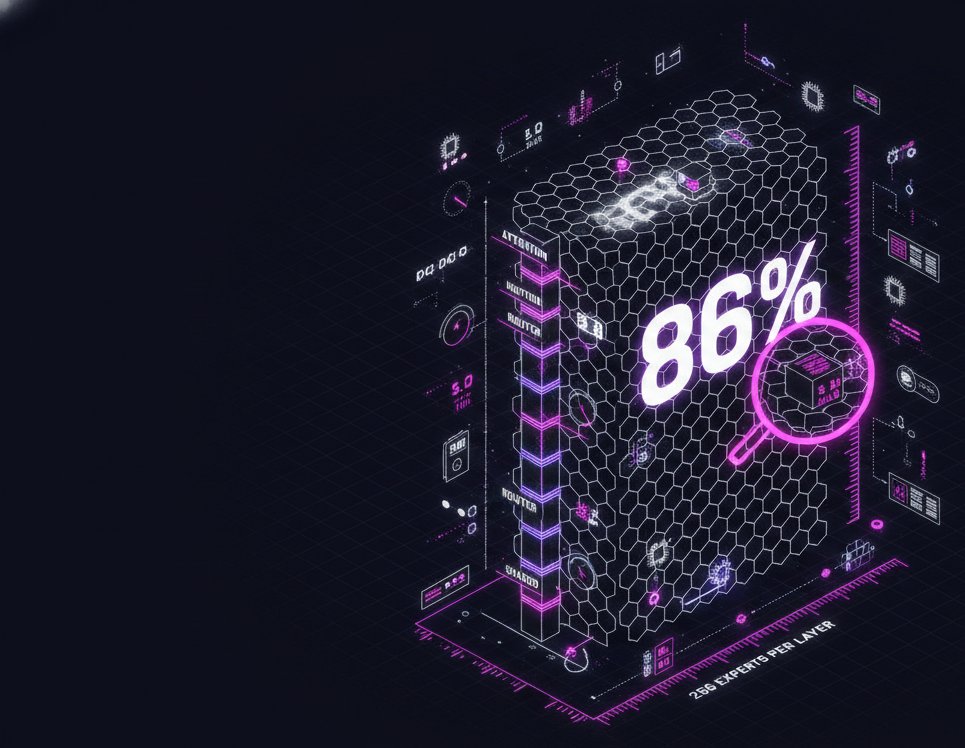
Each layer splits into a dense path — attention + KV, the norms, the router (ffn_gate_inp), a shared expert — and an expert bank: 256 independent FFNs stored as three stacked tensors (ffn_up_exps, ffn_gate_exps, ffn_down_exps). The dense path is the minority of the bytes; the expert bank is 86% of the model.
Experts are contiguous, block-aligned slabs
- The expert index is the outermost ggml dimension (
ne[2]) of every expert tensor — expert *e* occupies one contiguous, quant-block-aligned slab of raw quantized bytes. - That makes per-expert extraction a byte-range copy:
data[a:b], no dequantization, no re-packing — an expert-sliced mini-GGUF is cheap to produce and bit-faithful. - Per token only 8 of 256 experts fire per layer, chosen by the router — so at decode time a layer's expert traffic is a handful of small matrix multiplies over one hidden vector.
The carrying unit drops from 1.4 GB to 5.3 MB
At layer grain, the least a node can hold is ~1.4 GB — out of reach for most phones once the app, KV and OS take their share. At expert grain, the unit is 5.3 MB, and a realistic contribution is 8–64 experts (42–340 MB) — comfortably inside any modern device. The experts are mutually independent, so ownership can be scattered arbitrarily and re-balanced freely. This analysis is what made expert-level sharding the design bet: the weights were already packaged in swarm-sized units — the network just had to honor the packaging.