The Kvasir Economy: A Virtuous Cycle of Cost and Reward
A decentralized inference network only works if the price consumers pay and the reward nodes earn reinforce each other. Here is the flywheel we're building toward, the spirals that kill it, and the three invariants that keep it turning.
Thesis: Kvasir is a two-sided market settled in one token — consumers pay KVR to infer, nodes earn KVR to serve. The whole design succeeds or fails on one property: those two sides must form a virtuous cycle, where each turn makes the next turn easier. Get that wrong and any price policy eventually collapses; get it right and the network grows *cheaper* as it grows *larger*.
It's tempting to treat cost and reward as a tug-of-war — every dollar a consumer saves is a dollar a node doesn't earn. That framing is a trap. In a healthy network they are the same flywheel seen from two ends: payments become rewards, rewards become supply, supply becomes capacity and lower prices, lower prices become more usage, and more usage becomes more payments. The question isn't how to split a fixed pie; it's how to keep the wheel turning so the pie grows.
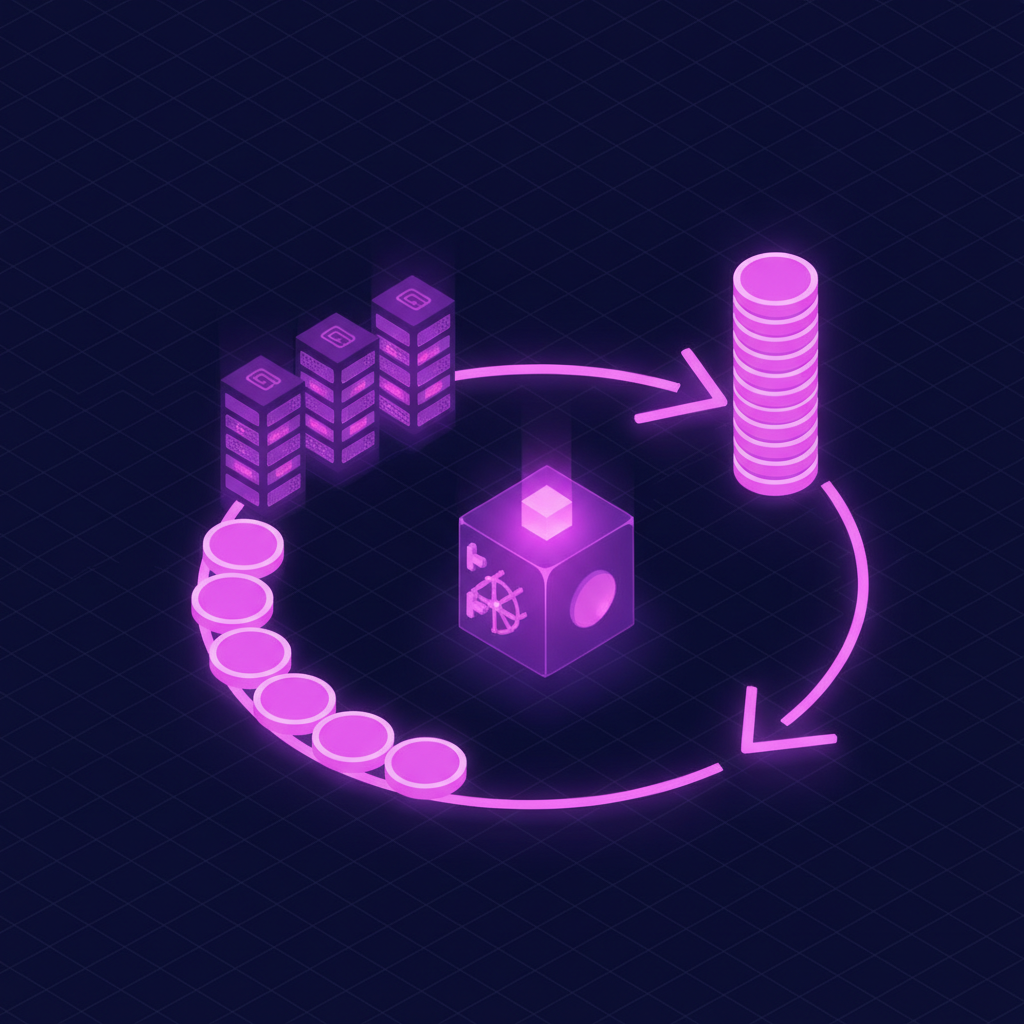
Why usage and supply grow together
The engine of the cycle is a single rule already true in Kvasir: inference must be paid in KVR. That ties the token to real usage — utility, not speculation. Usage funds the KVR that nodes earn; fair rewards pull in supply; supply expands capacity and, through competition and finer expert-sharding, drives the marginal cost of serving down; cheaper, faster, more capable service pulls in more usage. Kvasir tightens the loop with a property no centralized API can copy: a participant can be consumer and supplier at once. The demand side and the supply side often grow inside the *same people*, which damps the imbalances that wreck one-sided markets.
Four spirals that run the wheel backward
A flywheel can spin down as easily as up. Naming the death spirals is how you design against them:
| Spiral | How it starts | Where it ends |
|---|---|---|
| Reward dilution | More nodes chase flat demand | Per-node reward falls, nodes leave, capacity drops |
| Price-too-low | Cheap price, rewards below node cost | Serving stops paying, supply and quality collapse |
| Price-too-high | Good rewards, but above market | Users pick a cheaper API, revenue dries up |
| Emission dependence | Rewards paid by minting, not revenue | Inflation erodes KVR until both sides give up |
Three rules that keep the cycle virtuous
- Rewards are funded by real revenue. At steady state, what nodes earn comes from what consumers pay — not from open-ended token emission. Emission is a bootstrap subsidy that must *taper* as fee revenue grows. Kvasir already helps here by rewarding real work — KVR per tokens actually served × layer share, not mere presence — so subsidy can't leak to idle 'mercenary' nodes.
- KVR is the mandatory medium. Because you can't infer without paying KVR, the token's role is tied to real usage instead of speculation — it is the unit of account for inference, not an investment.
- Price floats inside a band. A floor kept above node marginal cost keeps serving worthwhile; a ceiling kept below centralized alternatives keeps Kvasir competitive. Between them, price moves — which is where the network's growth finally shows up as lower cost.
Making "more nodes → cheaper" true in code
Today price is a governed constant — sensible for a devnet, but it means adding nodes raises *capacity*, not affordability. The design direction is a utilization-driven price: idle supply nudges the price down toward the floor, congestion nudges it up toward the ceiling. That single signal turns the intuition *"the more people share compute, the cheaper it gets"* into a rule the protocol enforces — while the floor keeps operators solvent so the supply that made it cheap doesn't evaporate. Because price is a sensitive economic parameter, it changes only under genesis-wallet authority with wallet-signature + 2FA, never a stray environment variable.
"Free" is the net, not the price. You pay for what you infer and earn for what you serve; contribute roughly as much as you consume and your bill nets to zero. No subscription API — Claude Max, a Codex seat — can offer that, because you can never be their supply side. With Kvasir you can run models your own machine can't hold *and* be paid for helping others run theirs.
None of this requires exotic mechanism design. It requires discipline about three things: reward from revenue, utility from usage, balance from a bounded floating price. Kvasir already ships the hard, honest parts — rewards paid to each node's own wallet, work-proportional rewards, a token you must actually spend to use the network. The rest is the economic roadmap: the taper, the fee split that funds an insurance pool for failed inferences, and the thermostat. Built in that order, cost and reward stop fighting and start compounding.