Phase 1 — The Ring: Pipeline Inference Without a Master
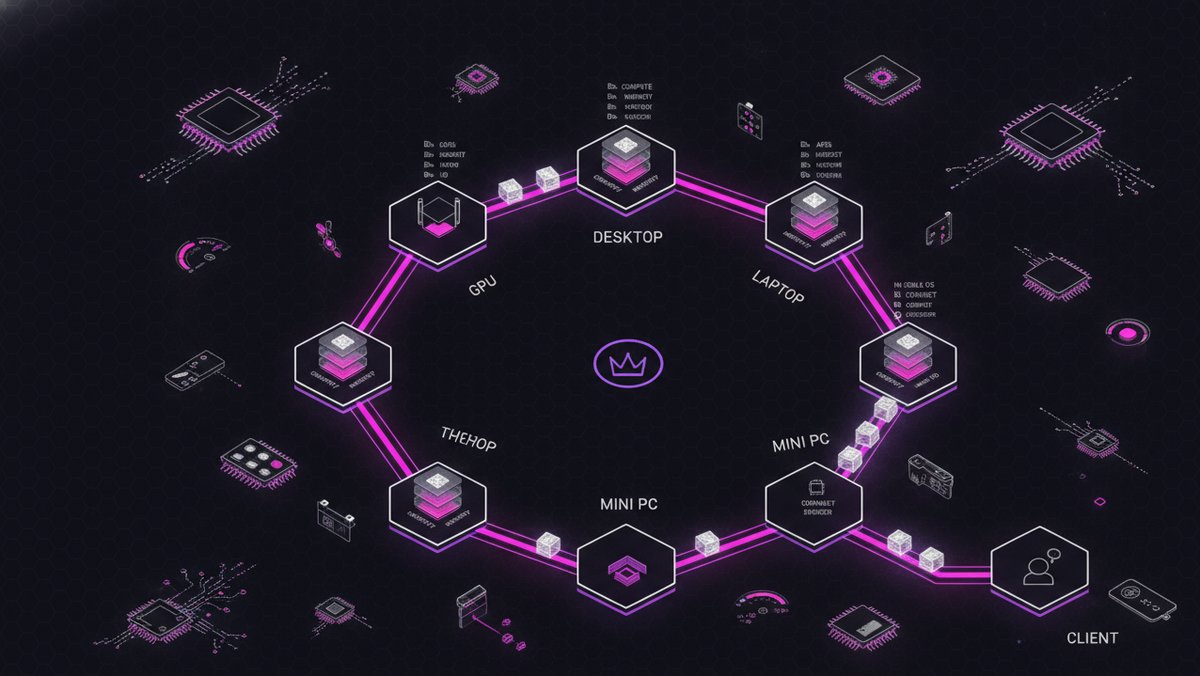
Every device loads only its layer window and passes a small hidden-state boundary to its neighbor. No node has to hold the whole model, and the ring has no central master.
The RPC master is a bottleneck and a gatekeeper
In the classic RPC topology one master opens the entire GGUF and dials out to every worker. That shape breaks in an open network three ways: the master must hold and serve the whole checkpoint; every worker must be dialable — phones behind carrier NAT are not; and the master is a single owner in a network that should have none.
Layer windows + boundary passing
- Every device stores the same model but loads only its contiguous layer window, then opens exactly two links: one to its predecessor, one to its successor.
- A request enters the ring; each node runs its layers and passes only the hidden-state boundary to its neighbor. The last rank samples the token and sends it back around — no central master on the data path, and no node holds the whole model.
- Placement comes from the planner's rank manifest — for Qwen3.5-122B, 49 layers split across whatever mix of GPU, CPU, NPU and phone shows up.
Partial shards, mobile GPUs, and the 443 relay
- Partial-shard download: a ring stage doesn't need the checkpoint — it needs its window. A stage mini-GGUF carries just those tensors (254 MB of 26 tensors versus the 77.6 GB full model), so a phone pulls ~1.5 GB for a one-layer window instead of everything.
- Mobile GPU path: the RPC route to a phone GPU proved infeasible (Adreno's OpenCL buffer layout doesn't survive RPC serialization), but a ring stage runs on the Adreno GPU directly — the stage owns its backend locally, so nothing crosses the wire but boundaries.
- NAT traversal: phones can't accept inbound connections, so the data plane runs through a 443 relay — a per-edge WebSocket bridge with a 1-byte role preamble that lets both ends dial outbound. The phone opens zero inbound ports.
- Self-enrollment market: stages are claimed, not assigned. A node polls the coverage/demand map, picks the highest-reward uncovered window, downloads that window, and joins — verified end-to-end with a NAT-bound phone completing ring inference and earning its contribution.
The low-latency path
The ring is Kvasir's latency path: boundaries are small, hops are few, and decode flows around the loop without gathering anything centrally. Its limitation is granularity — the smallest unit a node can carry is a layer (~1.4 GB on the 122B). Removing that floor is what the expert-sharded swarm does; the ring remains the serving backbone it plugs into.